

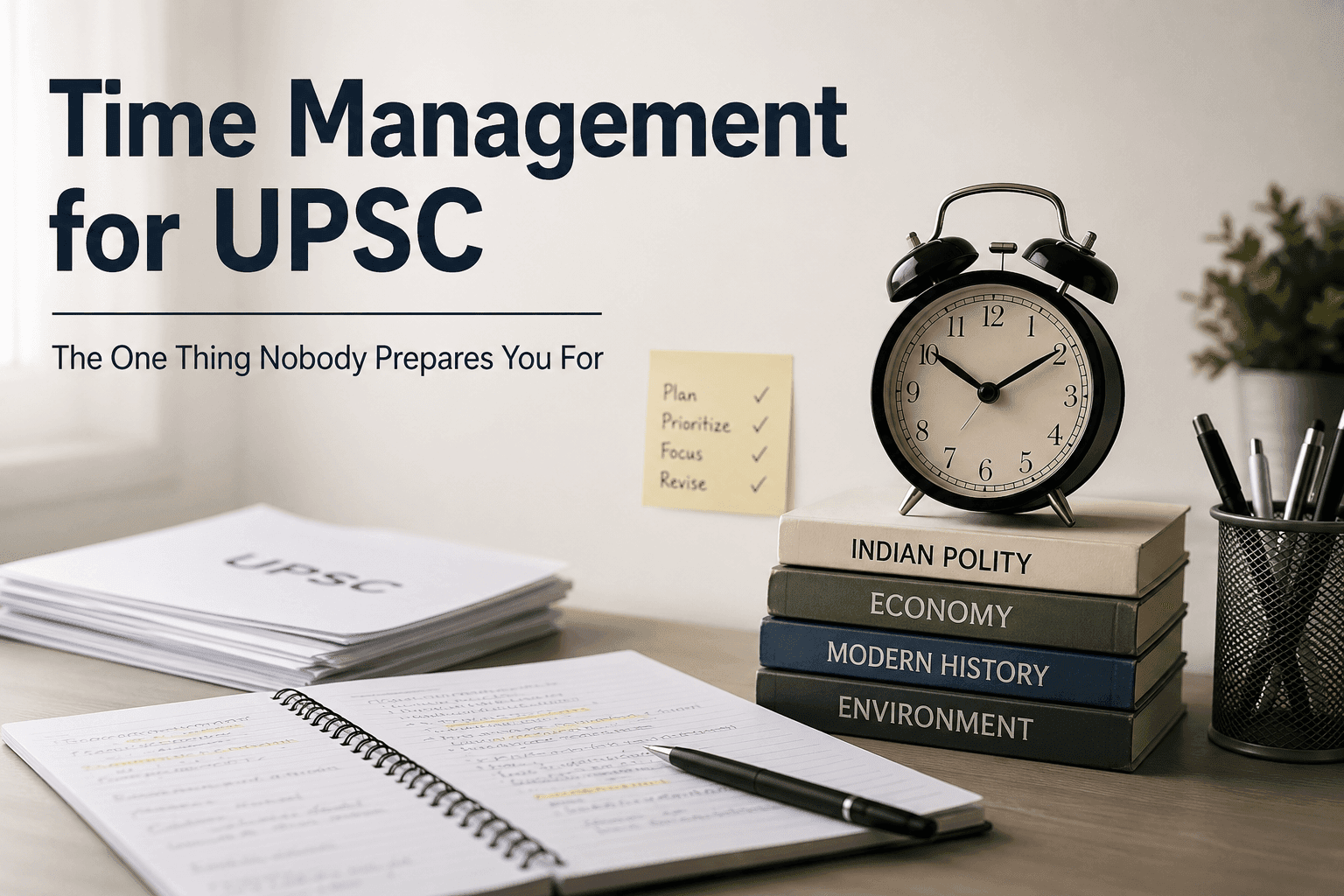
Time Management for UPSC: The One Thing Nobody Prepares You For
Let me be honest with you from the start. When I began my UPSC preparation, I thought the exam was about knowledge. About how many books you have read, how many facts you can cram, how many hours you can sit at that study table without getting up. I was wrong. Beautifully, painfully wrong.
The UPSC Civil Services Examination is not a test of how much you know. It is a test of how well you manage what little time you have — both across the two years of your preparation and inside those three-hour exam halls where your entire dream sits on the tip of your pen. Nobody tells you this properly. Everybody keeps talking about the syllabus, the optional subject, the newspaper. But the real game, the silent game, is time.
So let me share what I have learned, plainly, the way I would tell a younger cousin who has just decided to attempt this exam.
Why Time is Your Real Optional Subject
Think about it. The syllabus of UPSC is basically the syllabus of life. History, geography, polity, economy, environment, science, ethics, current affairs — the whole world is fair game. You can study for ten years and still feel underprepared. This is precisely the trap. Because the syllabus is infinite and your time is finite, the aspirants who win are not the ones who study everything. They are the ones who decide, ruthlessly, what to study and what to leave.
This decision-making is time management. When you choose to revise Laxmikanth for the fourth time instead of picking up a new polity book, that is time management. When you close the newspaper after forty-five minutes instead of getting lost in the sports page for two hours, that is time management. It is not about clocks and timetables only. It is about priorities.
The Macro Level: Planning Your Months
Before we talk about daily routines, we must zoom out. Most aspirants make timetables for their day but never for their year. This is like a driver who plans every turn but has no idea of the destination.
Sit down with a calendar. Mark your Prelims date. Count backwards. You will suddenly realise that the comfortable "one year of preparation" is actually much less once you remove the days you will fall sick, the family functions you cannot avoid, the days your motivation will simply vanish, and the revision cycles you absolutely must keep aside.
A rough thumb rule that worked for me: divide your total preparation time into three unequal parts. The first and largest part goes to building your base — reading the standard books, making notes, understanding concepts. The second part goes to answer writing and revision. The third, and this is the part everyone underestimates, goes purely to revision and mock tests in the last two to three months before Prelims. If you have not kept this last block sacred, you will enter the exam hall with a head full of half-remembered facts.
The mistake I see again and again is aspirants who are still reading new material two weeks before Prelims. They have covered so much yet retained so little, because they never left time to go back over what they read. Reading once and revising thrice beats reading thrice and revising once. Remember that.
The Micro Level: Winning the Day
Now let us come to the daily grind, because this is where dreams are either built or quietly buried.
I am not going to give you a rigid timetable with slots painted like a school timetable, because your life is not mine and your energy patterns are your own. Some people are sharpest at five in the morning. Others come alive only after the sun goes down. Instead of copying someone else's schedule, observe yourself for one week. Notice when your mind is fresh and when it is foggy. Then be strategic — put your hardest, most concept-heavy subject in your peak hours, and keep the lighter tasks like current affairs or revision for the low-energy slots.
A few principles I swear by:
Study in blocks, not in marathons. Sitting for six hours straight sounds impressive but your brain switches off after the first ninety minutes or so. Break your study into focused blocks of around fifty minutes with short breaks in between. During those breaks, please do not touch your phone. That five-minute Instagram scroll has a way of becoming forty minutes, and worse, it drains the very focus you are trying to build.
Do the difficult thing first. There is a wonderful trap in productivity where we do all the easy, pleasant tasks first and keep telling ourselves we will do the hard subject "later in the evening." Later never comes with full energy. If Economy scares you, open Economy first thing in the morning. Eat that frog, as they say.
Have a fixed slot for current affairs. The newspaper is both a blessing and a black hole. Give it a fixed time, ideally one to one-and-a-half hours, and stop when the time is up. Do not read every editorial like it is a novel. Learn to skim, to pick what matters for the exam, and to leave the rest. Making short monthly current affairs notes will save you from drowning later.
The Exam Hall: Where Time Becomes Brutal
Everything above is about the journey. But there is a second, sharper battle — managing time inside the actual exam. And here, seconds matter.
In Prelims, you have one hundred questions and two hours. That is roughly one minute and twelve seconds per question, but of course you should not think that way. The smart approach is to go through the paper in rounds. In the first round, attempt only the questions you are absolutely sure of. Do not stop at a tough question and stare at it — mark it and move on. In the second round, come back to the ones where you can eliminate two options and make an educated guess. Save the truly unknown ones for the last, and take a calculated call on how many risks you can afford given the negative marking. Panicking over one hard question at the start and losing your rhythm has failed more aspirants than lack of knowledge ever did.
In Mains, the tyranny of time is even worse. You have to write around twenty answers in three hours. Do that arithmetic — that is barely seven to eight minutes per answer, including thinking, structuring, and writing. This is why answer-writing practice is not optional. You cannot walk into Mains hoping to figure out your speed on the day. You must have practised so much that your hand knows the rhythm of a seven-minute answer without you consciously watching the clock.
The golden rule of Mains is to attempt every question. An average answer to every question scores far more than brilliant answers to half the paper and blanks for the rest. Aspirants who spend fifteen minutes crafting a perfect answer for question one and then run out of time for the last five questions are, sadly, writing their own rejection letter. Allot your minutes per question and be disciplined enough to leave an answer unfinished and move on when the time is up. You can always come back if minutes remain at the end.
The Part We Do Not Talk About: Rest is Also Time Management
Here is something the coaching brochures will never print. Managing your time also means managing your rest, your health, and your mind. An aspirant who studies fourteen hours a day for a week and then burns out for the next ten days has managed time far worse than one who studied a steady eight hours every single day.
Sleep is not laziness. A tired brain forgets what it read. Exercise is not a waste of study hours — a thirty-minute walk clears your head better than a third cup of coffee. And please, keep a small window in your week for the things and people who keep you sane. This exam is a marathon, sometimes run over several attempts, and you cannot sprint a marathon.
I have seen brilliant aspirants crack under the weight of guilt — the guilt of every unstudied hour, every break taken, every day the timetable was not followed perfectly. Let me tell you gently: no aspirant in history has ever followed their timetable perfectly. The timetable is a compass, not a cage. If you miss a slot, do not spend the next three hours mourning it. Adjust and move on. Consistency over months beats perfection over a single day.
A Few Honest Words Before You Go
If there is one thing I want you to carry from all this, it is this — treat your time the way you would treat money in a poor household. Spend it carefully, account for every unit, cut the wasteful expenses, and always keep some in reserve for emergencies. The aspirant who respects time is the aspirant time eventually rewards.
You will have bad days. Days when the timetable collapses, when the concepts refuse to stick, when the phone wins and the books lose. That is fine. That is human. What matters is that you return to your desk the next morning and begin again. The clock does not care about your feelings, but it does reward your habits.
Prepare smart, rest well, revise more than you read, and walk into that exam hall knowing you gave your finite hours to something worth every one of them.
All the best. You can do this.