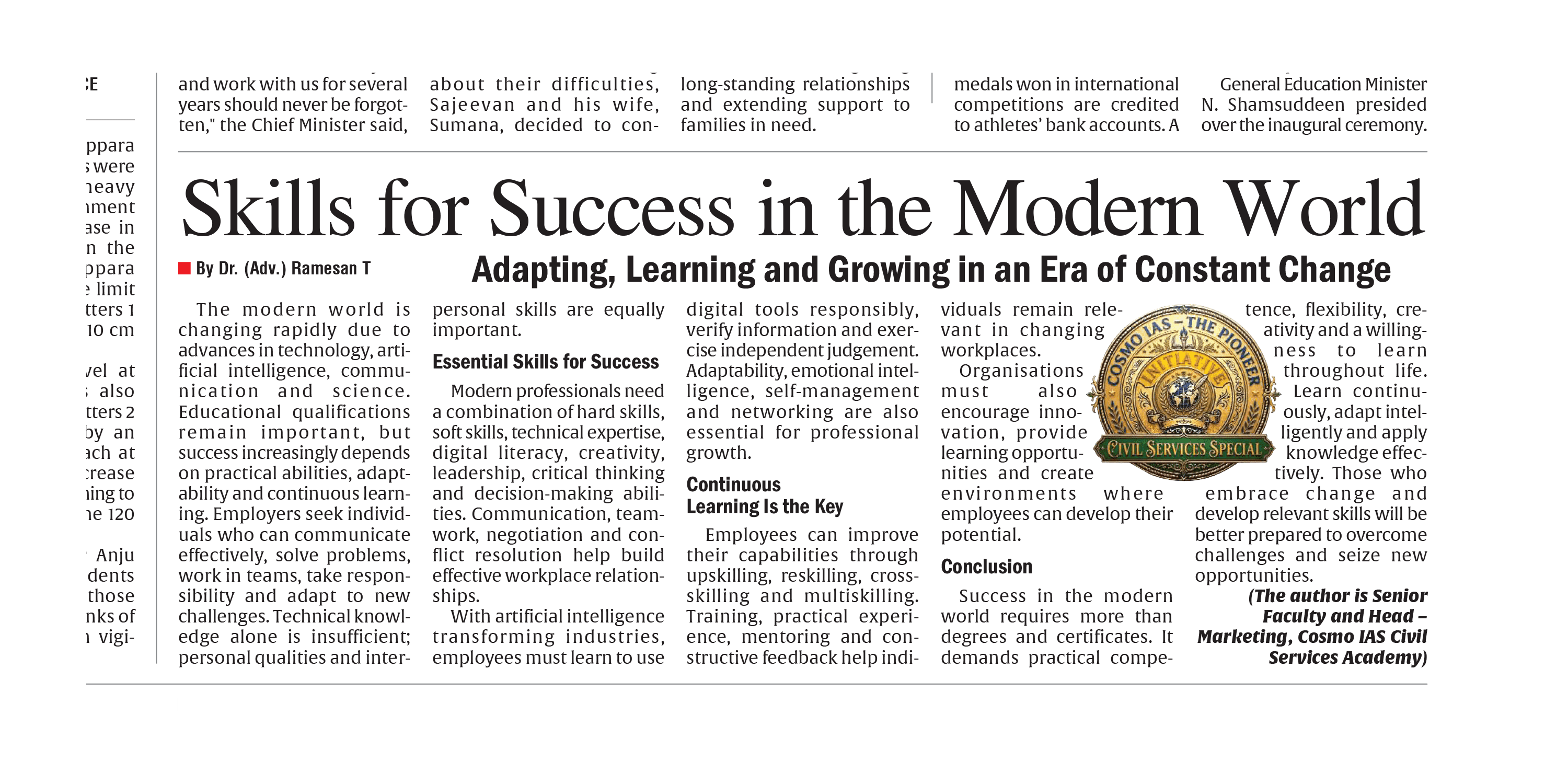
We live in an era of unprecedented change, with developments every day in every sphere. Advances in science, technology, communication and artificial intelligence have transformed how we live, learn, work and interact. The world has become a global village, where information travels in seconds and opportunities once impossible are now within reach.
Compared to their grandparents, today's youth have enormous access to information and global opportunities. India, with 65 percent population below 35, has a unique demographic advantage. But this becomes a dividend only if youth are skilled. Access to information alone does not guarantee success. The ability to understand, apply and convert knowledge into productive action is what matters.
Change is eternal. Those who embrace change and equip themselves with relevant skills progress, while those unwilling to learn fall behind. Today, qualifications alone are insufficient. Individuals must develop technical expertise, personal qualities and practical skills to remain competitive.Why Are Skills Becoming Essential?
Modern industries need competent, disciplined, adaptable and willing-to-learn employees. Employers seek people who communicate effectively, work collaboratively, solve problems and accept responsibility.
Earlier, a degree was considered enough. Today, it only helps you enter the job market; abilities, attitude and performance decide growth. Automation, digitalisation and AI are transforming workplaces rapidly. Those who fail to update knowledge find skills irrelevant, while learners discover opportunities. Skills are no longer desirable additions to a résumé. They are essential for employability and personal growth.
Understanding Different Types of Skills
-
Hard and Soft Skills: Hard skills are specific, measurable abilities acquired through education like programming, accounting and data analysis. Soft skills relate to behaviour like communication, teamwork, empathy and leadership. A technically qualified person may struggle without communication, and vice versa. Success needs balance.
-
Transferable and Job-Specific Skills: Transferable skills like writing, critical thinking and problem-solving apply across industries and provide mobility. Job-specific skills like structural design for engineers or financial reporting for accountants ensure competence in a particular role. Both are needed.
-
Life and Professional Skills: Life skills like decision-making, time management and emotional regulation help manage daily challenges. Professional skills acquired through training meet requirements of professions like medicine, law or teaching. Together they ensure productive life.
-
Social and Interpersonal Skills: These include listening, expressing ideas clearly and cooperating with colleagues. Modern workplaces bring diverse backgrounds. Respect and cooperation are essential. Technical competence may get a job, but teamwork decides contribution.
-
Cognitive, Numerical and Analytical Skills: Cognitive skills involve reasoning and learning. Numerical skills involve interpreting data, identifying patterns and assessing risks. Important in finance, research and administration, these help examine evidence and reach conclusions through reason, not assumption.
-
Technical, Digital and AI Skills: Technical skills enable use of specialized tools, essential in engineering and healthcare. Digital skills are now mandatory as workplaces depend on computers and data. AI literacy is newest necessity. Those who understand AI tools improve productivity, but must verify outputs, recognize limitations, protect data and exercise independent judgement. Technology should strengthen human capability, not replace thinking.
-
Physical Skills: These involve coordination, strength, precision and balance, seen in a surgeon's hands or athlete's movement. Despite technology, they remain indispensable in healthcare, sports, construction and skilled trades.
-
Management and Self-Management Skills: Management is not only for managers. Every employee must manage time and resources. Organisational skills involve planning and meeting deadlines. Self-management includes discipline, emotional control and self-motivation. Those who manage themselves handle pressure better.
-
Adaptive Skills and Inclusiveness: Adaptability is responding positively to new situations and technologies. Inclusiveness is respecting differences and ensuring everyone feels valued. Adaptable, inclusive employees work effectively with diverse teams.
-
Creative and Innovative Skills: Creativity generates original ideas; innovation applies them for practical value. Organisations need employees who improve products or simplify procedures. Innovation need not be revolutionary; small effective improvements can make big difference.
-
Leadership and Decision-Making Skills: Leadership is guiding and motivating people towards common goal, setting example and accepting responsibility. It is not confined to executives; an employee taking initiative also shows leadership. Decision-making involves evaluating alternatives and accepting accountability.
-
Problem-Solving and Conflict-Resolution: Every organisation faces challenges. Problem-solving means identifying root cause and implementing solution. Conflict resolution means listening to different parties and finding fair solution. Objective is not winning argument but settling issue while protecting relationships.
-
Communication and Customer-Relations: Communication means speaking clearly, writing effectively and listening attentively with courtesy and clarity. Negotiation helps reach agreements through reasoned arguments. Customer relations involves understanding expectations and building trust. Sustainable success depends on delivering value.
-
Academic, Research and Learning Skills: These include gathering information, evaluating sources and presenting findings accurately, vital in education and policymaking. Learning skills enable acquiring new knowledge. Where knowledge doubles fast, willingness to learn tomorrow matters more than knowing everything today.
-
Intrapersonal and Networking Skills: Intrapersonal skills involve self-awareness, emotional regulation and resilience to manage stress. Networking involves building meaningful relationships through mutual respect and trust, not just collecting contacts.
Upskilling, Reskilling, Cross-Skilling and Multiskilling
As industries evolve, four approaches matter. Upskilling is improving existing skills for current job, like accountant learning data tools. Reskilling is learning new skills for different role. Cross-skilling is learning from related departments to improve collaboration. Multiskilling is handling wider responsibilities. These benefit both employees and organisations.
How to Develop Skills?
Individuals should assess strengths and professional requirements, then pursue continuous learning through education and practical experience. Practice is key. Communication improves through interaction, leadership through responsibility. Seek feedback from mentors. Organisations must also provide training and supportive environment.
Conclusion: Never Stop Learning
Qualifications remain important, but value multiplies when supported by competence, communication and adaptability. No one needs to master every skill; requirements vary by profession.
Message is simple: learn continuously, adapt intelligently and apply knowledge effectively. Do not wait until change threatens you. Anticipate it. In a world that never stops moving, standing still is disadvantage. Those who develop combination of skills will not only survive change but lead it. Ultimately, success belongs not to those who merely possess knowledge, but to those who consistently transform it into meaningful and impactful results for society.