
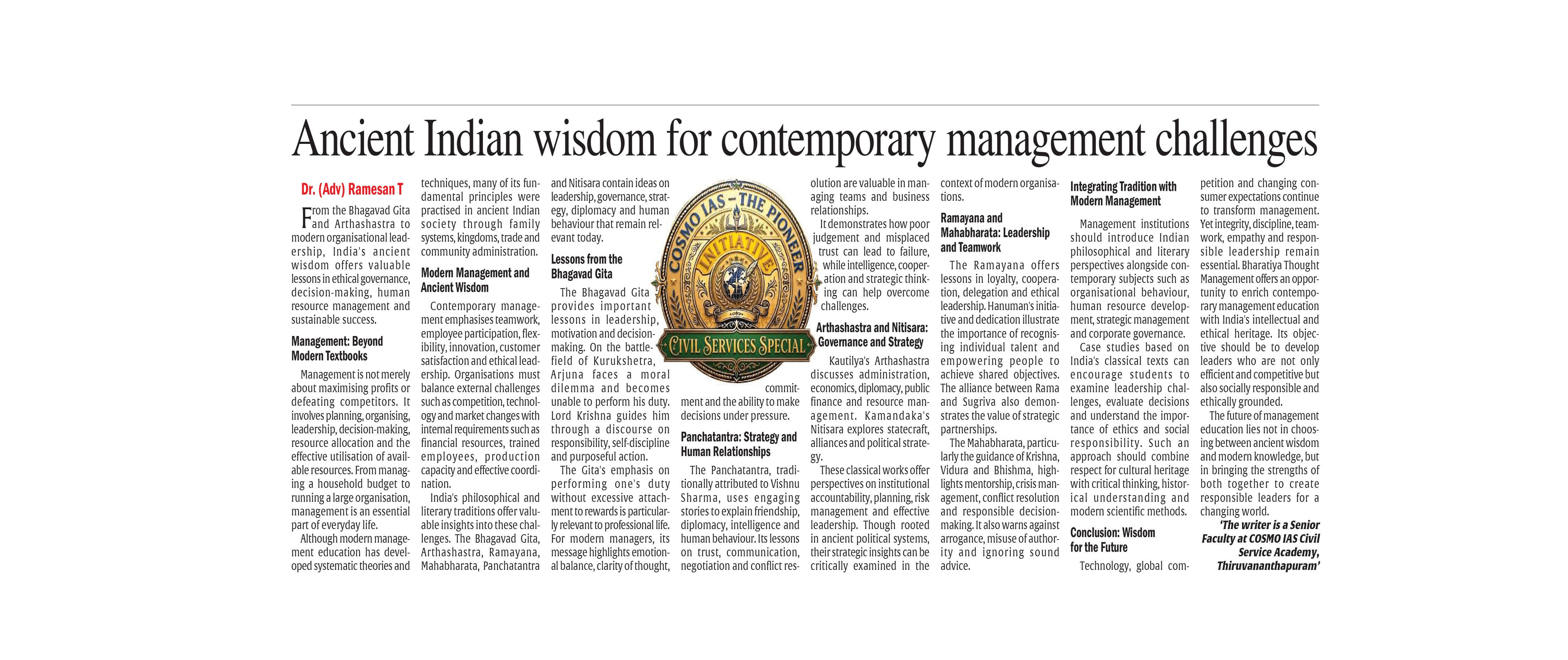
Management: Beyond Degrees and Textbooks
Management is one of the most essential skills in both professional and personal life. A homemaker managing a limited household income, a wage earner striving to save money after meeting family expenses, and a shopkeeper setting aside funds for future expansion are all practising management in their own ways.
Management, therefore, did not begin with modern business schools. Our ancestors practised it in their households, communities, kingdoms and economic activities, even though they did not use today's terminology.
Nor is management merely about maximising profits, defeating competitors or capturing markets. It involves planning, organising, decision-making, resource allocation, leadership, coordination and the efficient utilisation of available resources.
The Changing Face of Modern Management
Modern management increasingly emphasises flexibility, employee participation, individual empowerment, people-oriented leadership and adaptability. A manager must understand external factors such as government policies, market conditions, consumer demand, competition, economic circumstances, social traditions, technological developments, transportation, logistics and environmental sustainability.
Internal factors are equally important. These include financial resources, departmental coordination, raw materials, machinery, production capacity, trained personnel, employee development, salary structures, rewards, customer feedback and human resource policies.
An organisation's success depends on effectively coordinating these factors. Competent leadership, efficient resource utilisation, teamwork and a shared commitment to quality enable organisations to satisfy customers and remain competitive.
These principles apply to manufacturing and service industries alike. Information technology, education, healthcare, hospitality, finance, transportation, tourism, recruitment and public services all depend on reliability and customer satisfaction. A minor lapse can damage an organisation's reputation, while poor-quality products may accumulate in warehouses and dissatisfied customers may move to competitors.
A product may initially attract buyers through publicity, novelty or competitive pricing, but its long-term acceptance depends on quality, reliability and value.
Contemporary management employs systematic approaches such as the systems approach, quantitative techniques, contingency theory, Total Quality Management (TQM), behavioural management and human-centric leadership. Technology, data-driven decisions, innovation and empowered teams have become increasingly important.
This raises an important question: Can modern management become more effective by drawing upon India's intellectual and philosophical traditions?
Bharatiya Thought Management: An Enduring Tradition
Bharatiya Thought Management (BTM) integrates insights from Indian philosophy, ethical traditions, cultural values and systems of governance with contemporary organisational leadership and strategic thinking. It is not necessarily an entirely new concept, since many of its principles are already reflected in modern management practices.
Total Quality Management, for example, emphasises continuous improvement, customer focus, employee participation, fact-based decisions, open communication and systematic planning. Several of these principles resonate with Indian philosophical values, including disciplined action, ethical conduct, collective responsibility, self-improvement and commitment to the common good.
Although TQM and Bharatiya Thought Management emerge from different intellectual frameworks, their shared emphasis on quality, responsibility and continuous improvement offers opportunities for meaningful integration.
The objective should not be to replace modern management theories but to enrich them with ethical insights and a deeper understanding of human behaviour.
India's great epics and classical works—including the Mahabharata, Ramayana, Bhagavad Gita, Arthashastra, Nitisara and Panchatantra—offer valuable perspectives on leadership, governance, diplomacy, conflict resolution and decision-making.
The Bhagavad Gita: Leadership, Motivation and Decision-Making
One of the most powerful examples of leadership and motivation appears in the Mahabharata.
On the battlefield of Kurukshetra, Arjuna becomes overwhelmed by grief and moral confusion when he sees his relatives, teachers and friends among his opponents. Unable to decide how to proceed, he lays aside his weapons and expresses his unwillingness to fight.
Lord Krishna, serving as his charioteer, guides him through a profound discourse on duty, self-knowledge, disciplined action and human responsibility. This dialogue, presented in the Bhagavad Gita, comprises 700 verses across 18 chapters.
Krishna's guidance transforms Arjuna's understanding of his responsibilities and helps him overcome indecision. The episode illustrates an important management principle: effective leaders and mentors must help individuals examine their doubts, understand their responsibilities and develop the clarity and confidence required for action.
The Gita's emphasis on self-control, emotional balance, disciplined effort and detachment from the exclusive pursuit of rewards remains relevant to professional life. Individuals should concentrate on the quality of their efforts rather than becoming paralysed by anxiety about outcomes.
Managers routinely face uncertainty, pressure and conflicting interests. Remaining composed, making considered decisions and guiding others through difficult circumstances are therefore essential leadership qualities.
The Panchatantra: Strategy, Diplomacy and Human Behaviour
Traditionally attributed to Vishnu Sharma, the Panchatantra uses animal fables and engaging narratives to explore friendship, alliances, intelligence, negotiation and the consequences of human behaviour.
Tradition associates the work with the education of King Amarashakti's princes, with stories intended to develop practical wisdom and an understanding of political and social relationships.
For management students, the Panchatantra offers lessons in communication, teamwork, conflict resolution and strategic alliances. Its stories demonstrate how misplaced trust, poor judgement and seemingly minor decisions can have serious consequences.
These insights remain useful in negotiations, business partnerships and competitive environments, where success depends not only on technical knowledge but also on understanding human motivations and exercising sound judgement.
Nitisara and Arthashastra: Governance and Strategic Thinking
Nitisara, attributed to Kamandaka, is a classical treatise on statecraft, diplomacy, political strategy and governance. Its discussions of alliances, interstate relations and the responsibilities of rulers offer historical perspectives on negotiation, competition, risk assessment and strategic decision-making.
The Arthashastra, traditionally attributed to Kautilya, explores administration, economics, public finance, diplomacy, intelligence, security and governance. It examines the practical responsibilities of rulers and the systems necessary for effective administration.
For contemporary management education, these works provide material for examining organisational strategy, resource allocation, institutional accountability and risk management.
Their historical context must be acknowledged, since ancient political systems differed substantially from modern democratic institutions and corporations. Nevertheless, a critical study of their strategic principles can deepen students' understanding of India's intellectual heritage and the relationship between leadership and public welfare.
The Ramayana: Ethical Leadership and Organisational Harmony
The Ramayana offers numerous narratives that can be examined through a management perspective. Its themes include duty, loyalty, cooperation, communication, leadership and the consequences of individual decisions.
The relationships among Rama, Lakshmana, Bharata, Hanuman and Sugriva provide opportunities to discuss teamwork, delegation, alliance-building and commitment to shared objectives.
The search for Sita and the subsequent campaign against Ravana can be examined in terms of strategic planning, information gathering, coordination and resource utilisation. Hanuman's initiative, adaptability and dedication illustrate individual responsibility and empowerment.
Similarly, the alliance between Rama and Sugriva demonstrates how cooperation between parties with different interests can help achieve a common goal.
These narratives encourage reflection on ethical leadership, recognising talent, assigning responsibilities according to ability, building trust and balancing personal interests with collective objectives. Such interpretations should promote critical discussion rather than treating every episode as a direct equivalent of a modern management technique.
The Mahabharata: Mentorship, Crisis Management and Responsibility
Beyond the Bhagavad Gita, the Mahabharata provides several situations relevant to leadership and organisational behaviour. The guidance offered by Vidura, Bhishma, Krishna and other figures illustrates the importance of mentorship, institutional knowledge, ethical judgement and listening to experienced advisers.
The epic also portrays centralised authority, delegated responsibility, competing interests and the consequences of fragmented leadership. The conflict between the Kauravas and the Pandavas demonstrates how mistrust, ambition, poor judgement and an inability to resolve disputes can escalate into a devastating crisis.
Management students can draw lessons concerning crisis preparedness, conflict resolution, risk assessment, stress management and stakeholder responsibility. The epic also raises questions about the misuse of power, the rejection of sound advice and the dangers of allowing personal ambition to override collective welfare.
These issues remain relevant in modern organisations, where ineffective communication, conflicting employee interests and unethical decisions can undermine performance and institutional reputation.
Integrating Bharatiya Thought into Modern Management Education
The examples discussed above demonstrate that leadership, motivation, communication, strategy, ethics and conflict resolution have long been explored within India's intellectual traditions. This does not mean that ancient texts contain every modern management theory in its present form. Rather, they offer philosophical, ethical and practical insights that can complement contemporary knowledge.
Management institutions should encourage students to study Bharatiya thought alongside organisational behaviour, strategic management, human resource development, corporate governance and business ethics.
Case studies based on the Ramayana, Mahabharata, Bhagavad Gita, Panchatantra, Nitisara and Arthashastra could help students analyse leadership decisions, evaluate alternative courses of action, participate in role-play exercises and compare traditional insights with modern management models.
Such an approach must combine respect for cultural heritage with critical thinking, historical awareness and evidence-based evaluation. Students should identify both the enduring value and the limitations of traditional ideas when applying them to contemporary organisations.
The ultimate objective is not merely to familiarise students with ancient texts but to develop better judgement, stronger ethical foundations, greater self-awareness and a comprehensive understanding of leadership.
Conclusion: Tradition as a Resource for the Future
Modern management continues to evolve in response to technological advances, global competition, changing consumer expectations and emerging organisational challenges. Yet integrity, discipline, cooperation, sound judgement and responsible leadership remain fundamental to success.
Bharatiya Thought Management can provide an additional intellectual resource for addressing these challenges. Connecting contemporary management practices with India's philosophical and ethical heritage can make management education more holistic, culturally grounded and socially responsible.
Our ancestors explored questions that continue to confront leaders: How should authority be exercised? How can conflicts be resolved? What motivates people? How should scarce resources be used? What responsibilities accompany power, and how can personal ambition be balanced with the common good?
These questions deserve a place in modern management classrooms.
Management institutions should integrate the wisdom of Bharatiya thought with contemporary scientific methods, professional skills and evidence-based practices. Such an approach can help develop managers who are not only efficient and competitive but also ethical, empathetic and conscious of their responsibilities to society.
The future of management education need not be a choice between ancient wisdom and modern knowledge. It can be a thoughtful synthesis of both—preserving the enduring strengths of India's intellectual heritage while equipping future leaders to meet the challenges of a rapidly changing world.
Dr. (Adv) Ramesan T, Senior Faculty, Cosmo IAS Civil Service Academy, Thiruvananthapuram.